
Bag Locks in Brief
A handbag lock should be designed by matching closure function, bag scale, opening feel, material, finish, logo detail and assembly method. Custom lock projects should be reviewed with drawings, samples or 3D files before sampling, because small structure changes can affect fit, function and production cost.
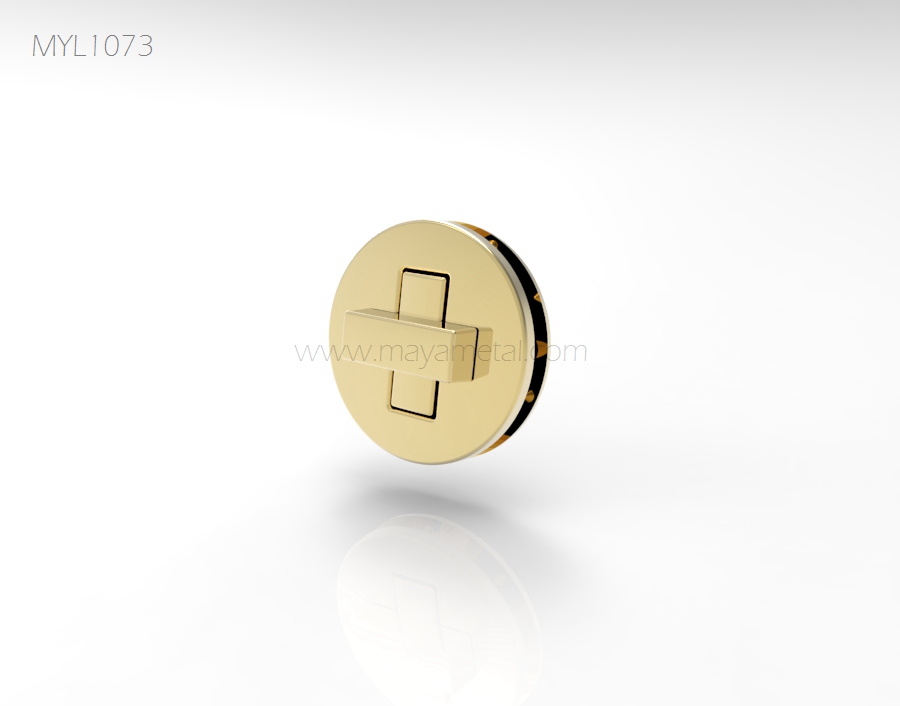
What Makes a Bag Lock Work Well?
A good bag lock does three things at once: it closes securely, it opens with a controlled and pleasant feel, and it looks correct on the bag. Failure in any one of these — a lock that pops open, a mechanism that feels gritty, or a scale that fights the design — makes the whole bag feel cheaper.
Function comes first in development. The lock must hold under normal carrying load, resist accidental opening, and survive repeated use cycles. Once function is proven, the opening feel — resistance, click quality and smoothness — becomes a brand signature worth tuning deliberately.
How Should Lock Size Match Bag Proportion?
Lock size should be decided from the bag's front panel dimensions and visual weight, not chosen from a catalog in isolation. A lock that is too small disappears on a large tote; a lock that is too large overwhelms a compact crossbody and can add unnecessary weight.
Designers should also check the space the lock mechanism needs inside the bag. The visible front plate is only part of the structure — the back mechanism and attachment points consume depth and width. Reviewing the lock against a paper pattern or prototype bag early prevents late-stage fit problems.
What Opening and Closing Structures Are Common?
Common structures include turn locks, push locks, twist locks, flip locks and magnetic-assisted closures. Each has a different opening motion, internal mechanism and assembly requirement. The choice should follow how the user opens the bag and how the flap or frame is built.
Moving structures need clearance, spring or cam elements and wear-resistant contact surfaces. Because small geometry changes can alter movement feel and tooling cost, structure decisions for custom metal handbag hardware should be frozen at the drawing stage and verified in a physical sample before production tooling is committed.
How Should Material Be Selected for a Bag Lock?
Brass is often chosen for locks that need premium weight, warm feel and deep plated finishes — a heavy front lock is a classic luxury signal. Stainless steel is often chosen when corrosion resistance, strength or a clean modern finish matters more than weight.
The material decision interacts with everything else: lock finish options, achievable polish quality, part weight and cost. Buyers should decide material together with finish, because plating, polishing and PVD behave differently on each base metal. Maya Metal manufactures custom bag locks in both stainless steel and brass for OEM/ODM projects.
How Should Logo Detail Be Handled?
Logo detail on a lock can be engraved, stamped or formed into the structure. Feasibility depends on available surface area, logo line thickness, material, finish and production method. Very fine logo lines risk filling in during plating or becoming illegible at small sizes.
Buyers should supply vector artwork with the intended placement and size, and review a physical logo sample before production. The logo should also be checked after finishing, because plating and antique effects change how engraved detail reads. For more on engraving depth, line thickness and artwork requirements, see our guide to logo engraving on handbag hardware.
Quality-Control Checklist for Custom Locks
Use the points below as a lock quality inspection checklist during sample approval and pre-shipment review.
- Dimensions match the approved drawing and fit the bag panel and flap.
- Opening and closing movement is smooth, with consistent resistance across parts.
- The lock holds securely under normal carrying load and resists accidental opening.
- Finish color and gloss match the signed master sample, including recesses.
- Edges are smooth and free of burrs that could damage leather or skin.
- Logo detail is legible and correctly placed after finishing.
- Assembly points are secure, with no looseness between front and back components.
- Packing protects polished and plated surfaces from scratching in transit.

