
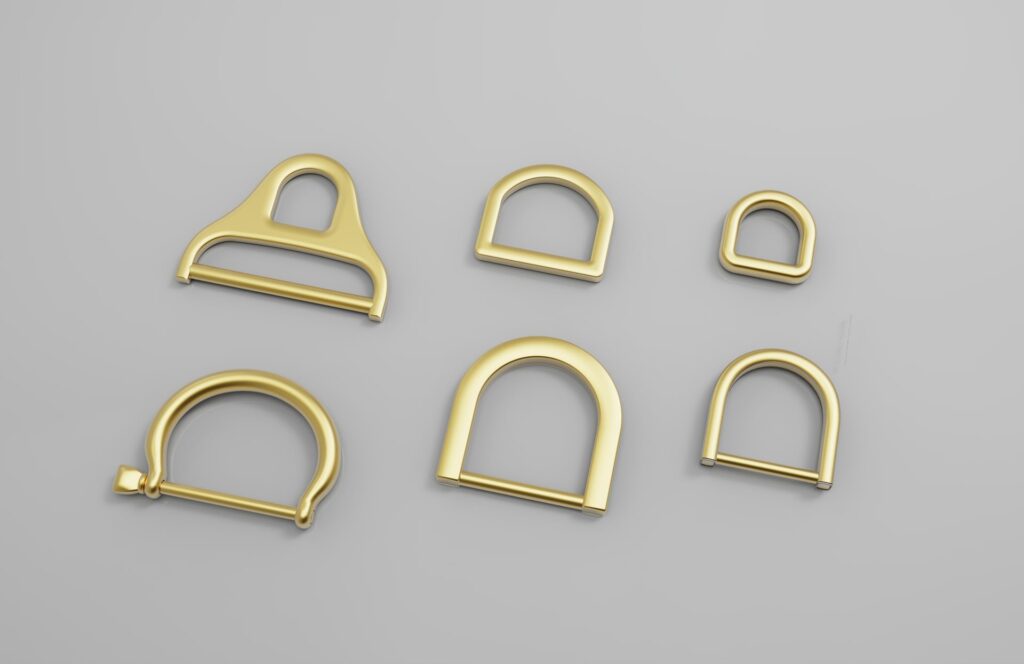
D Rings: The Short Answer
A D ring should be designed around strap width, wire diameter, inside clearance, load requirement, material and finish. For handbag and luggage projects, D ring dimensions must match the strap, and the finish must match the rest of the hardware set on the same bag.
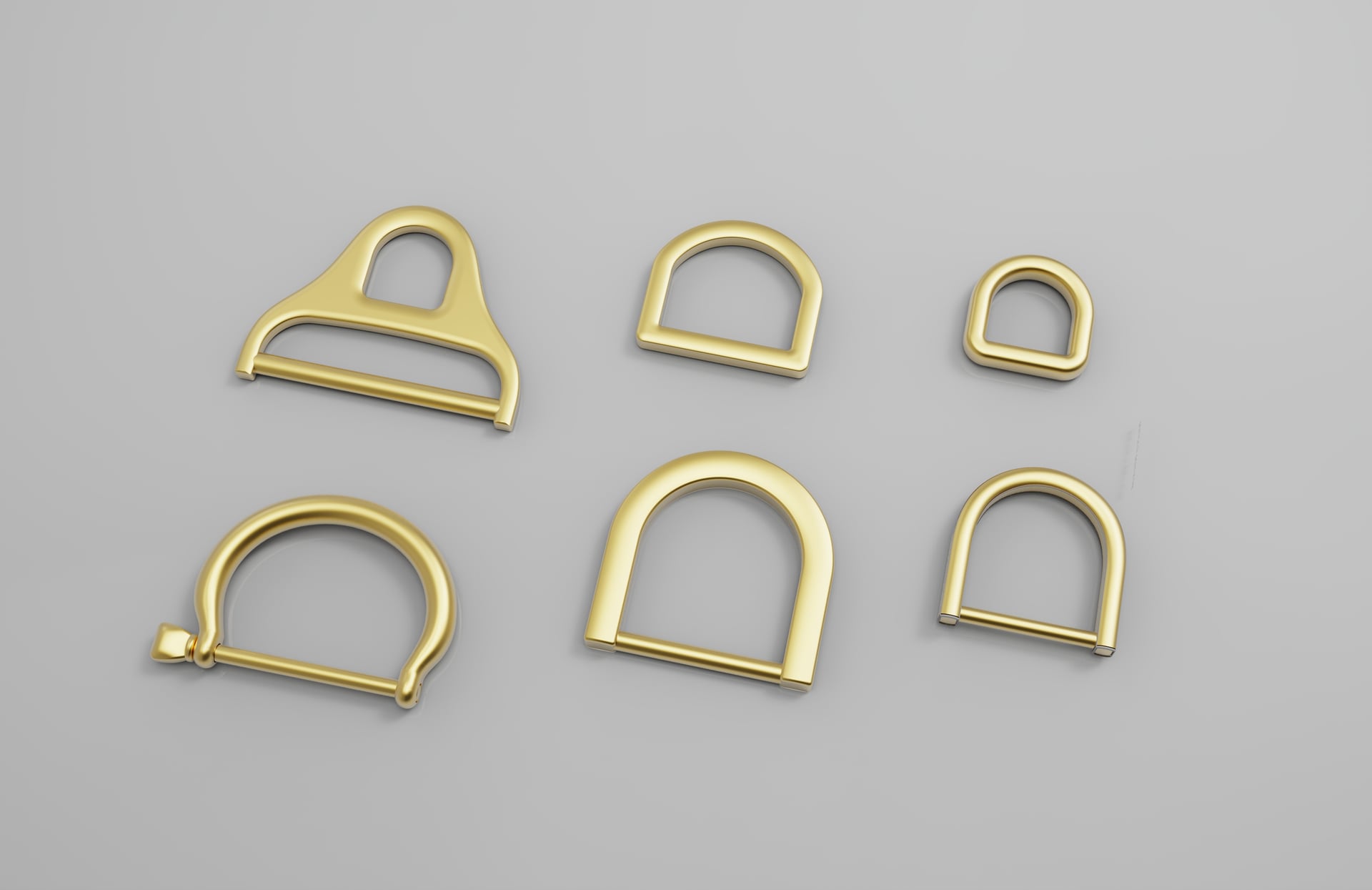
What Is a D Ring?
A D ring is a metal ring shaped like the letter D, with one straight side and one curved side. In handbags and luggage, D rings connect straps, handles, chains and hooks to the bag body. The straight side usually sits against the strap or attachment tab, while the curved side carries the connected hardware.
D rings look simple, but they are load-bearing parts. When specifying custom D rings and O rings, a poorly sized or poorly finished D ring can twist straps, wear leather, deform under load or break the visual consistency of the hardware set. Treating them as engineered parts rather than generic findings prevents most sourcing problems.
How Do Inside Width and Strap Fit Work?
Inside width is the clear opening of the ring, and it must match the strap width. A ring that is too narrow bunches the strap and creases leather; a ring that is too wide lets the strap slide and twist, which looks untidy and wears the strap edges.
The working rule is that the inside width should accommodate the strap width plus its thickness with a small clearance, so the strap can move without grinding against the ring. Buyers should test the actual strap material — leather, webbing and coated fabric behave differently — on a physical sample before approving dimensions.
How Do Wire Diameter and Strength Relate?
Wire diameter is the thickness of the metal forming the ring. Thicker wire generally increases load capacity and rigidity, but also increases weight and visual bulk. The correct diameter balances the expected load, the bag's style and the weight the user will carry.
Load requirements should come from real use: a decorative handle attachment on a small handbag needs far less strength than a shoulder strap anchor on a loaded travel bag. Where strength matters, buyers should state the expected load in the RFQ so the manufacturer can advise on wire diameter, material and construction. Any load or strength testing requirement should be agreed with a named method before production.
Stainless Steel vs Brass D Rings
| Criteria | Stainless Steel D Rings | Brass D Rings |
|---|---|---|
| Strength | Usually higher for the same size | Good for moderate loads |
| Corrosion resistance | Strong | Depends on finish protection |
| Weight | Moderate | Heavier |
| Finish options | Polished, brushed, PVD when suitable | Polished and plated decorative finishes |
| Typical use | Strap anchors, exposed and moving parts | Decorative or premium-feel attachments |
The choice should follow function first, then finish matching. For load-bearing parts, stainless steel hardware compared with zinc alloy often wins on strength and corrosion resistance, so it pays to review all hardware material options before deciding. Mixing materials on one bag is possible but makes color matching harder, so the finish set should be approved together.
How Should D Ring Finish Match the Hardware Set?
D rings almost always appear next to other hardware — snap hooks for D ring attachment clipped into them, buckles on the same strap, locks on the same panel. Their finish must match those parts in both color and gloss. A polished ring beside a brushed hook reads as a mismatch even if the color name is the same.
Buyers should approve the full hardware set against one signed master sample under consistent lighting, and confirm the finish after assembly-style comparison, with the ring and hook actually connected.
Inspection Points for D Rings
- Inside width fits the strap with correct clearance.
- Wire diameter matches the approved sample and drawing.
- Ring shape is consistent, with no visible deformation.
- Welds or joints, where present, are closed, smooth and positioned discreetly.
- Surface is free of burrs and sharp edges that could cut leather or fabric.
- Finish color and gloss match the master sample, including the straight side.
- The ring moves freely in its attachment without binding.

