
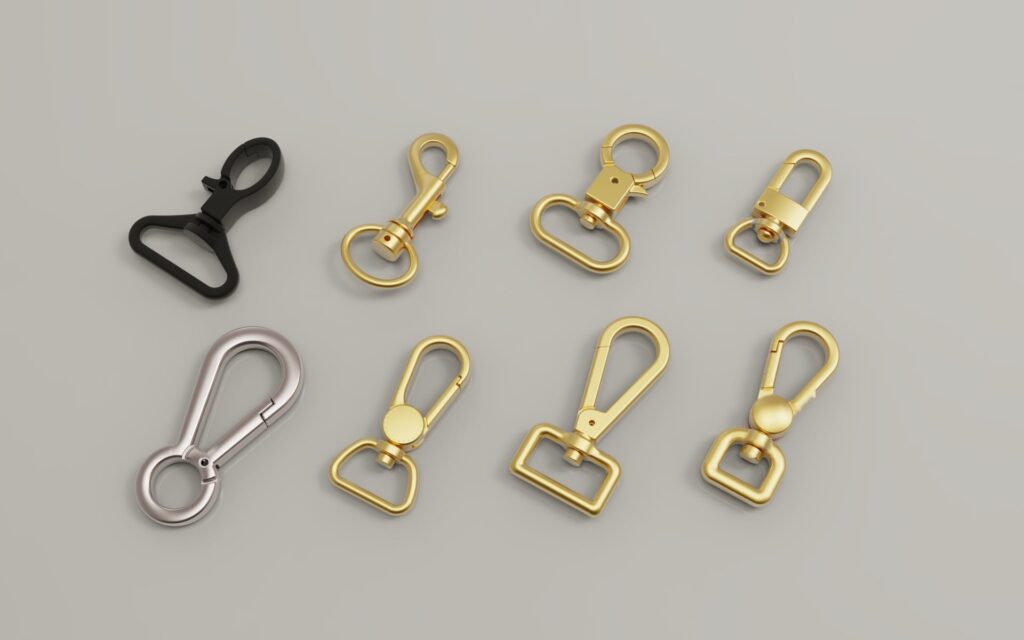
Snap Hooks at a Glance
Bag hooks should be selected by strap width, opening clearance, spring-gate function, swivel rotation, strength requirement, material and finish. Snap hooks are used for attachment, while swivel hooks add rotation to reduce strap twisting during use.
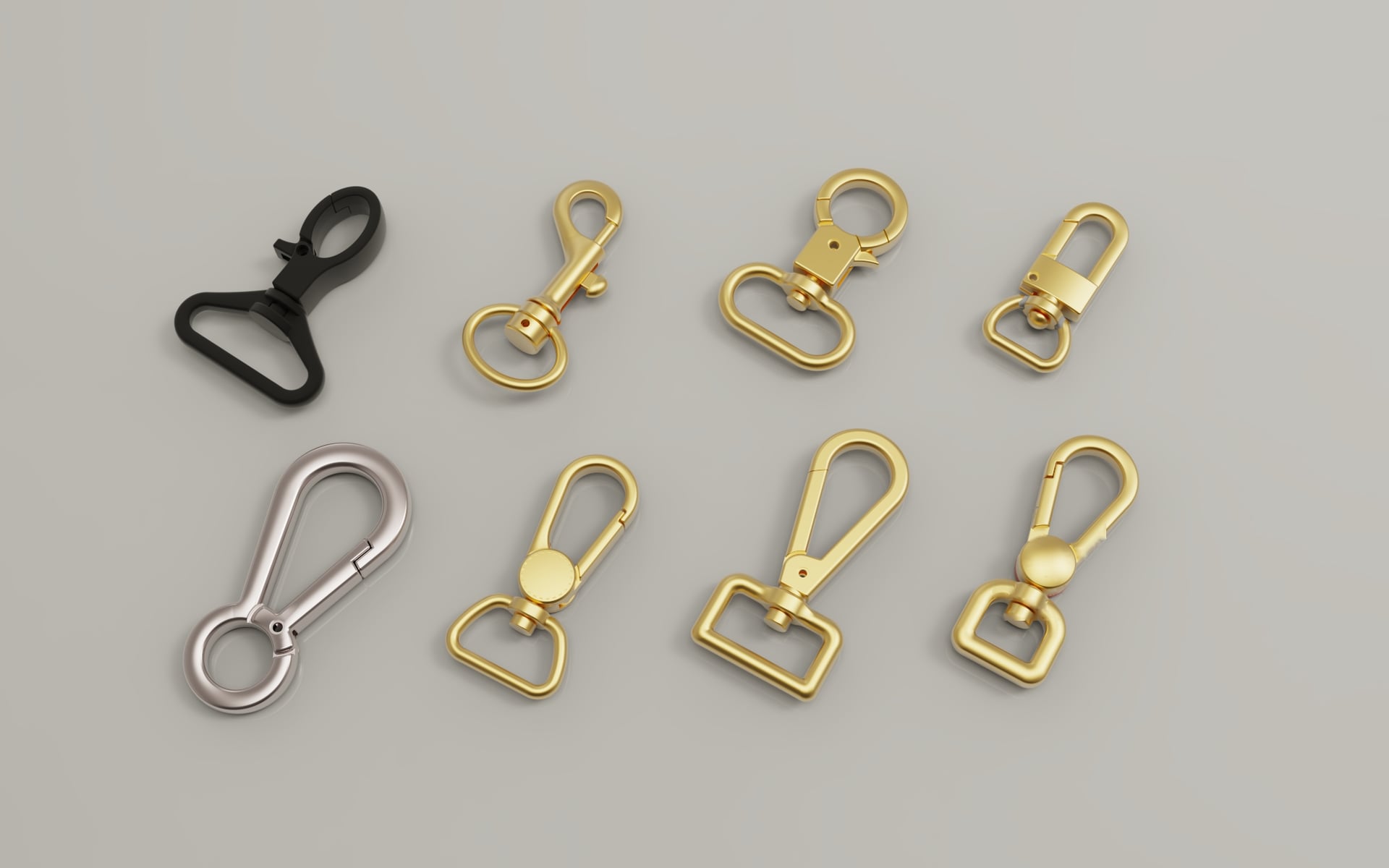
Snap Hook vs Swivel Hook: What Is the Difference?
A snap hook is a hook with a spring-loaded gate that opens for attachment and closes automatically. It connects straps to D rings, O rings and other anchor points on the bag. A fixed (non-swivel) snap hook holds its orientation relative to the strap.
A swivel hook adds a rotating joint between the strap eye and the hook body. This rotation lets the hook turn freely, which reduces strap twisting when the bag moves on the shoulder. Swivel hooks are the common choice for adjustable shoulder straps; fixed hooks suit applications where orientation must stay controlled. Both types can be ordered as custom snap hooks and swivel hooks to match strap width, ring size and load requirements.
How Should Hook Opening Size Be Chosen?
The gate opening must clear the hardware the hook attaches to — usually the wire diameter of a D ring or O ring plus working clearance. An opening that is too small makes the bag frustrating to use; one that is excessively large can look out of proportion and may allow the ring to sit loosely.
Buyers should specify the hook together with the ring it will attach to, because the two parts work as a pair. Testing the actual hook on the actual ring during sampling catches clearance problems that drawings alone can miss. Ring dimensions, wire diameters and tolerance considerations are covered in detail in the D ring design guide.
What Matters in Spring Gate Design?
The spring gate must open smoothly, close completely and stay closed under load. Gate quality shows up in three places: the spring force (enough to close decisively, not so much that the hook is hard to use), the gate-to-body fit when closed (no gap or misalignment), and durability over repeated opening cycles.
Weak springs and worn gate contacts are among the most common hook complaints after sale. Buyers should define an opening-cycle expectation for the product's use and agree a function check with the manufacturer. Gate alignment should be inspected on every sample, since even small misalignment reads as poor quality on a premium bag.
Why Does Swivel Rotation Matter?
A swivel that binds defeats its purpose: the strap twists, the bag hangs awkwardly and the hardware wears unevenly. A good swivel rotates freely under load without wobble or grinding, and keeps rotating smoothly after extended use.
Swivel quality depends on the joint structure and its tolerances. Buyers should test rotation with the strap actually loaded, not just by spinning an empty hook, and should check that the swivel does not loosen over repeated movement. Any play or rattling in the joint should be caught at sample stage.
How Should Material and Finish Be Selected?
Stainless steel is often chosen for hooks because it combines strength with corrosion resistance — important for a moving part handled constantly and exposed to weather and skin contact. Brass is often chosen where premium weight and plated decorative finishes matter, such as visible hooks on luxury designs.
Finish must match the rest of the hardware set: the hook, its D ring, and nearby buckles or chains should be approved together against one master sample. Because hooks move against rings, buyers should also check finish wear at contact points, where plating wears first. Available hook finish options differ in wear resistance, so the finish should be chosen with these contact points in mind.
Hook Inspection Checklist
- Strap eye fits the strap width with correct clearance.
- Gate opens smoothly and closes fully, with no gap or misalignment.
- Gate spring force is consistent across parts.
- Swivel rotates freely under load, without wobble, grinding or rattling.
- Surfaces and edges are smooth, with no burrs that could scratch leather or skin.
- Finish color and gloss match the signed master sample, including recesses.
- No finish wear at ring contact points after movement testing.
- Overall dimensions match the approved drawing or sample.

