
Pin or Automatic? The Short Answer
For most dress and casual programs, specifying a pin buckle for belt production is the safe default: a simple frame-and-prong mechanism that fastens through punched holes, slim enough for suit trousers and easy to size. An automatic belt buckle (ratchet buckle) replaces holes with a toothed track inside the strap, giving quarter-inch micro-adjustment and a clean front — popular for dress, uniform and golf belts. Plate and frame styles cover western and statement designs. Maya Metal manufactures custom metal belt buckles in solid brass and 304 stainless steel across all three mechanisms, with matched finishes for belt and bag collections.
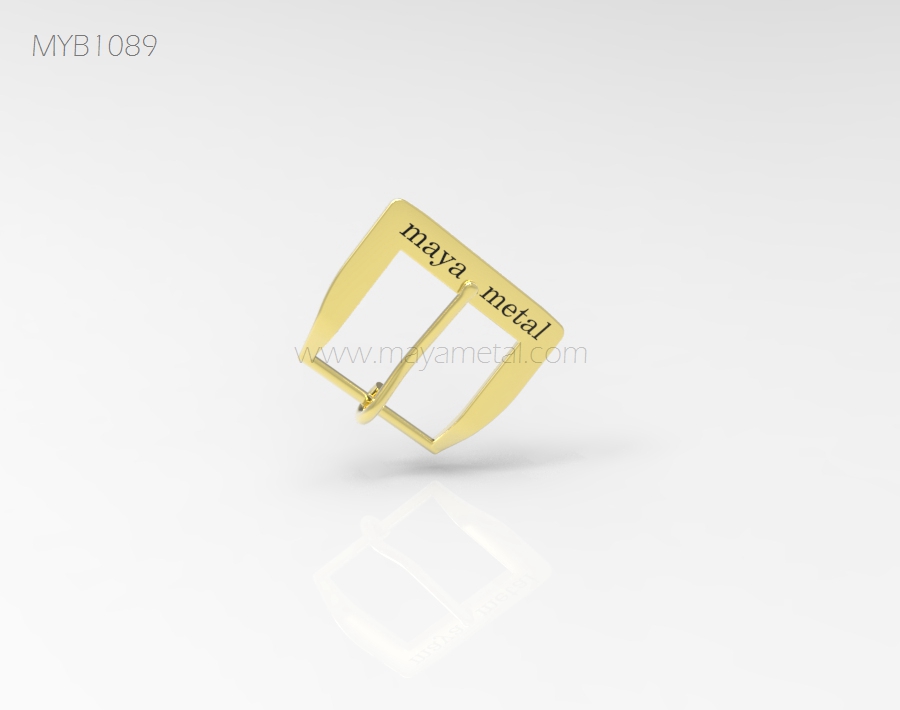
What Is a Pin Buckle and How Is It Built?
A pin buckle — also called a tongue buckle — is the oldest belt mechanism still in volume production. It has few parts, and each one is a specification point:
- Frame — the outer loop, usually rectangular or rounded, sized so the strap passes through with minimal side play
- Prong (tongue) — the pin that passes through the strap hole; its root thickness determines bending strength
- Crossbar — the bar the prong pivots on and the strap folds around; on heel-bar buckles it sits at the frame end, on center-bar styles in the middle
- Keeper loop — a separate metal or leather loop that holds the strap tail, often ordered as a matched set with the buckle
The strap is punched with holes, typically five to seven at one-inch spacing. Because nothing moves except the prong pivot, a well-made pin buckle in brass or stainless steel easily outlives the leather it is mounted on.
How Does an Automatic (Ratchet) Belt Buckle Work?
An automatic buckle clamps onto a strap that carries a toothed track on its underside. Inside the buckle, a spring-loaded pawl drops into the teeth and locks; a small lever or button lifts the pawl to release. The result is adjustment in roughly quarter-inch steps across thirty or more positions, with no holes to stretch, crack or misalign.
The strap is cut to length from the buckle end and secured in the buckle’s jaw with set screws or a clamping plate, so sizing happens at first wear rather than at the cutting table. For buyers, mechanism quality lives in three places: the pawl spring force, the precision of the tooth profile, and the track material bonded into the strap.
Where Do Plate and Frame Buckles Fit?
Beyond the two volume mechanisms, three families cover most decorative programs:
- Western buckles — large three-piece sets (buckle, keeper, tip) with cast relief, engraving or inlay; the buckle is the visual centerpiece of the belt
- Plate and plaque buckles — a flat front plate carrying a logo or emblem, with a hook or clamp fastening behind; common for uniforms, military-style webbing and promotional belts
- Box-frame and roller buckles — enclosed frames for workwear and heavy casual belts, where the roller reduces strap wear
These styles sell the buckle as jewelry. Tooling cost is higher because the front face carries the design, so they suit programs where the buckle itself is the differentiator.
Should You Specify Brass or Stainless Steel?
Solid brass casts and engraves beautifully, takes every plating finish from polished gold to antique silver, and has the warm weight customers associate with premium leather goods. It is the default for western buckles, logo plates and anything with relief detail. Unlacquered brass develops patina, which heritage brands treat as a feature.
304 stainless steel wins on corrosion resistance, surface hardness and nickel-allergy safety in skin contact. It suits automatic buckles — where springs and pawls benefit from harder material — and any belt sold into humid or coastal markets. For a fuller material comparison, see our stainless steel vs. brass guide; the same trade-offs apply to buckles.
Zinc alloy fills the budget tier for complex cast shapes, but it bends where brass and steel spring back — specify it knowingly, for fashion-price programs rather than work belts.
What Are the Make-or-Break Specs When Ordering Buckles?
- Belt width matching — the buckle’s inner width should match the strap within about 1 mm; oversized frames let the strap wander and look cheap
- Prong strength — ask for the prong root thickness; a thin prong in soft material will bend on a tight cinch over time
- Ratchet track life — for automatic buckles, request lock-release cycle test data and confirm the teeth still hold at the end of the test
- Hole spacing — standard pin-buckle straps use five holes at 25 mm spacing from the size point; confirm against your size grading
- Attachment method — screw-back, clamp or fold-over; screw attachments let retailers swap buckles and simplify repairs
- Weight — a large western buckle in solid brass can exceed 150 g; check the balance on your actual strap leather
Before You Order: Belt Buckle Checks
Before approving buckles for mass production, check:
- Fit on the real strap — width clearance and prong engagement for pin styles, clamp grip and track engagement for automatic styles
- Mechanism cycling: prongs flexed on pin buckles, automatic buckles locked and released a few hundred times with no spring fade
- Finish match across buckle, keeper and tip, and against any matching bag hardware in the same collection
- Edge quality where the strap folds — no sharp crossbar corners cutting the leather grain
- Material confirmation (solid brass or stainless vs. plated zinc) on the approval sample, by weight and a discreet file test if needed
- Spare screws and track sections for automatic buckles in after-sales kits
Send us your strap widths, target mechanisms and finish references — our team will recommend buckle constructions, quote tooling for custom shapes and produce fit samples on your strap leather.

